It all started with a grant.
In 2001, DMACC received funding to train manufacturers across Iowa in LEAN – a process improvement methodology originally developed in manufacturing to reduce waste, improve flow, and make work easier and more effective.
Over the years, what began as external training became something much bigger: a way of thinking that would eventually shape how DMACC solves problems across the entire institution.
At its core, LEAN is a systematic approach to eliminating waste – not people, not positions, but steps, handoffs, delays, errors, and redundancies that make work harder than it needs to be.
“LEAN isn’t just brainstorming ideas in a meeting,” said Machelle Sabin, who leads LEAN training at DMACC. “It’s a structured way to look at how work actually happens, identify what isn’t adding value, and then fix it – together.”
LEAN requires the people who do the work to help redesign it, Sabin emphasizes.
For systemic change to stick, collaboration is key – a lesson learned early on by the LEAN team.
In 2011, as DMACC worked to strengthen its LEAN approach internally, the Nursing Department requested support to create more efficient workspaces. The LEAN team began with a supply closet that was overcrowded, disorganized, and difficult to use.
Unlabeled supplies and blocked pathways forced faculty to spend time searching through clutter while teaching nursing courses. Supplies were duplicated, mislabeled, and hard to find. Students felt the ripple effects in class.
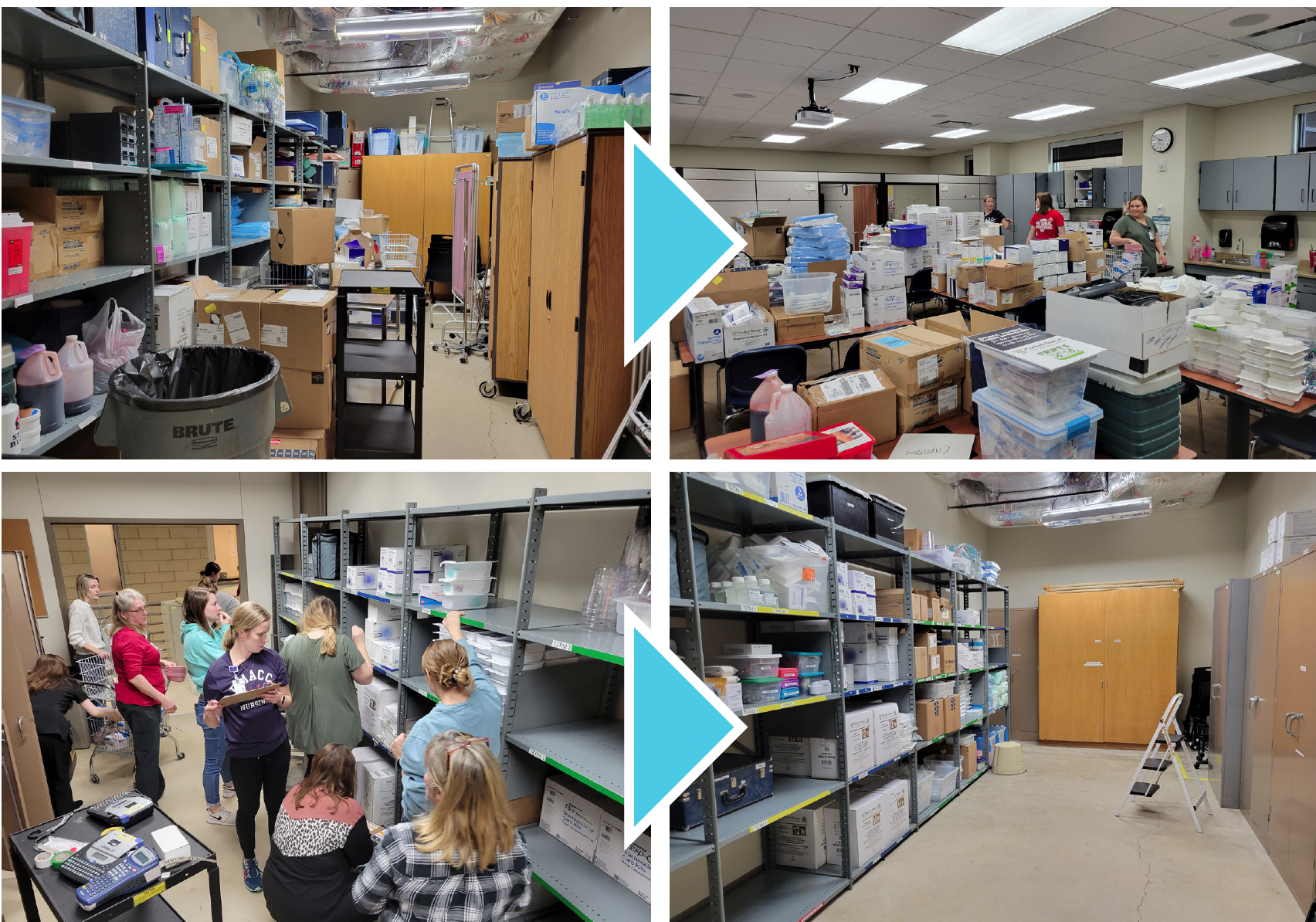
LEAN 5S was used to “Sort, Set in Order, Shine, Standardize, and Sustain” the closet, so everything had a clear place and purpose.
But the initial project did not succeed in the last component of the process because the people who used the supply room opted out of being involved in the redesign.
Old habits returned, and there was resistance to the changes – a common challenge.
As Sabin put it, “Everybody gets a seat at the table – and that’s why the fixes stick.”
The messy supply room became a turning point. 
“It showed us that process improvement is physically tangible,” said Debbie Kepple-Mamros, Executive Director of Institutional Effectiveness. “Something as simple as organizing a closet can improve efficiency, reduce frustration, and ultimately improve learning.”
Today, the tools have matured into a shared institutional toolkit.
The approach has scaled from physical spaces to digital ones — from equipment closets to SharePoint sites, registration workflows, and enterprise software decisions.
Between 2006 and 2025, DMACC completed 168 internal LEAN projects, using process mapping and 5S across departments and campuses.
Over time, LEAN stopped being a “special project” and became part of how the college manages change.
When DMACC implemented Guided Pathways, for example, LEAN principles helped cross-functional teams map roles, reduce friction, and bring people along through one of the most significant institutional shifts in recent history. The same methodology supports ongoing work in admissions, payroll, technology upgrades, and governance.
One recent example: dual enrollment.
Before LEAN mapping, staff were manually entering 2,000–2,400 course records each semester across multiple, inconsistent processes. The work was time-consuming and error prone. Through LEAN process mapping, the team is finding ways to clarify roles, reduce handoffs, improve data quality, and create a clear roadmap for future technology investments
“Now we can go to a software vendor and say, ‘Here’s our current state. Here’s our future state. Can you meet the requirements we need?’” Sabin explained.
Rewind to the early 2000s, when DMACC participated in statewide LEAN training through an Iowa community college consortium that launched a basic program and filed the Workplacelean™ trademark. DMACC later acquired exclusive rights and operationalized Workplacelean™ as a Lean-based system for capturing and sharing institutional learning.
Nowadays, that’s what sets DMACC apart.
“Because we’re able to teach other schools, because we’ve developed a template, and a curriculum that can help another institution on how to implement lean in their environment,” Sabin said.
For this work, DMACC was named a Top 10 finalist for the Bellwether Award in the category of Planning, Governance, and Finance — one of only three national categories recognized by the Bellwether College Consortium, an independent national think tank and network of community colleges focused on addressing critical institutional issues through research, innovation, and best practices.
“We’re being recognized for the way we’ve expanded the role of community college in workforce training and development,” Kepple-Mamros said.
While the name may not be instantly recognizable to every DMACC employee or student, it’s the sort of recognition that is noticed by the people who influence funding, partnerships and credibility, Kristin Brookover, Associate Vice President of Student Affairs, explained. Brookover is leading the dual-enrollment process improvement and part of the team representing DMACC in San Antonio.
Think of it like the difference between walking into a restaurant in Central Iowa and seeing a CityView “Best of Des Moines” plaque on the wall versus a Michelin Star (not to discredit the former recognition, of which DMACC has won “Best Community College” for the past decade.)
Bellwether can open doors, giving DMACC name recognition in national conversations, among peer institutions, and possibly, access to grant opportunities that are often invitation-only. Large philanthropic funders look for evidence that institutions can manage complexity, measure outcomes, and scale transformative ideas.
LEAN gives DMACC evidence.
As Kepple-Mamros noted, “The dollars that follow recognitions like this can be institution-changing.”
For Sabin, the real reward isn’t the award.
“It’s watching people’s work lives get easier,” she said. “When a process changes and someone says, ‘I don’t have to print and file this anymore,’ or ‘This used to take hours and now it doesn't' ... that’s the win.”
LEAN doesn't fix every problem. But it creates clarity. It exposes where processes are breaking down, and it builds trust by giving everyone a voice in the solution.
Later this month, a DMACC team will travel to San Antonio for the Community College Futures Assembly, where Bellwether finalists share their models with peers from across the country.
DMACC will share the story of how the LEAN model became a mindset: that when the people closest to the work are trusted to improve it, progress compounds.
And at a college built on access and opportunity, that commitment to continuous improvement is far from finished.