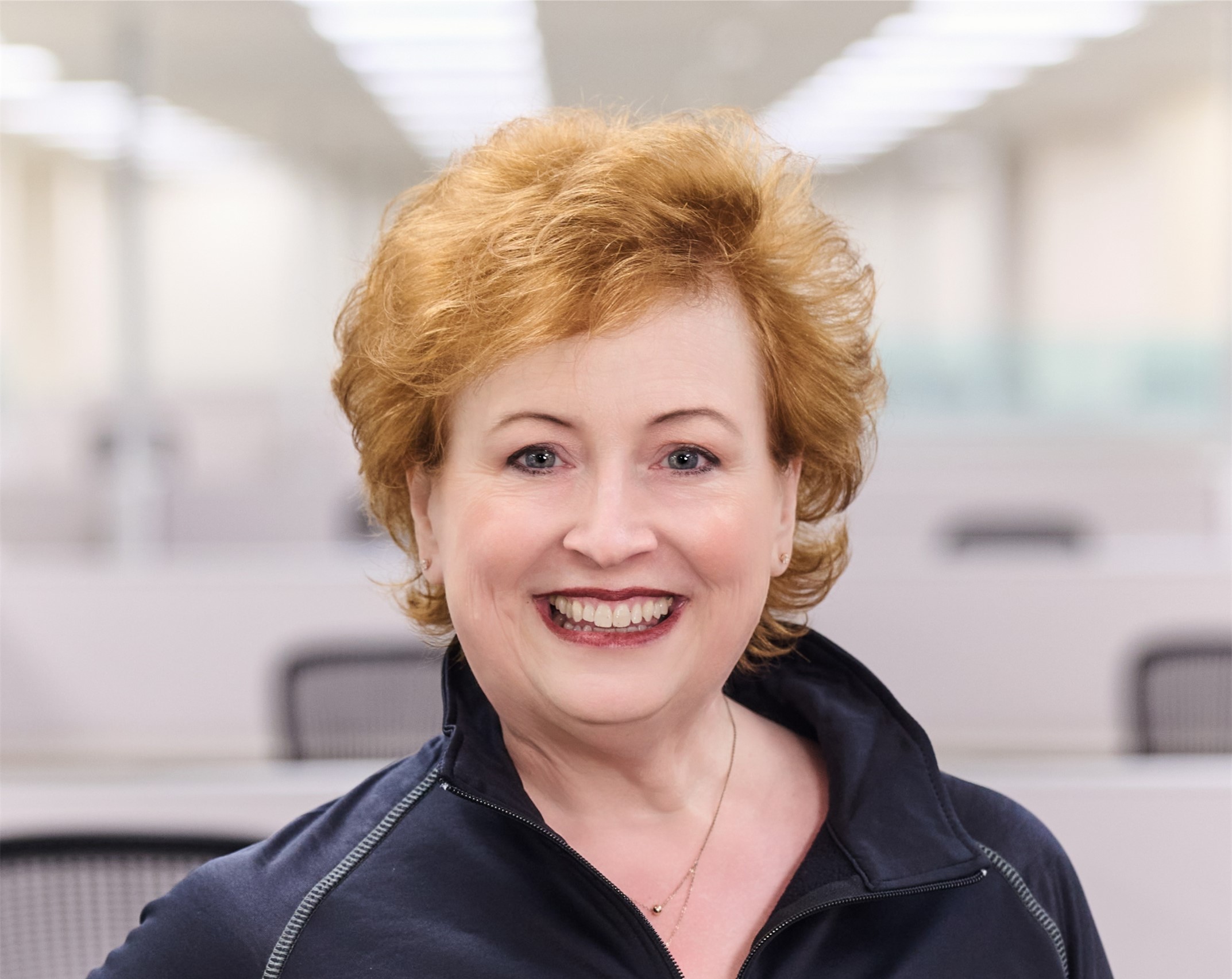
You might say Des Moines native Melissa Chavas Miller, consultant with DMACC Business Resources, thrives because of the unexpected.
For example, quickly pivoting to deal with a bomb threat during her first day of student teaching at Hoover High School in Des Moines. “A nice lady from the office” simply handed Melissa a folded note that told her to evacuate students immediately, leaving her without a clue where to take her students. So she applied calm logic, read instructions posted on the classroom door, and shepherded students out to safety.
Later, sitting in the privacy of the teachers’ lounge trying to calm down, Melissa picked up a newspaper and noticed an ad for a film acting class. She enrolled. During the class someone played an industrial video that caught her attention. The video, featuring Art Bauer, President of American Media, shared his philosophy, “E + I = C (emotion plus information equals communication), which is vital to create shared understanding.” That resonated with her so much that she looked at the person with the video and exclaimed, “Can I have your card? I want to work for that man.”
Des Moines-based American Media was the number one producer of how-to training films in the United States at the time. The next day, Melissa called the company and got an interview with the Director of Sales. That led to nine years with American Media, first in sales, then a team leader and trainer, then as Director of Training and Employee Development.
The bomb threat, the ad in the paper, the Art Bauer video, all of these unexpected things led Melissa to her first career.
During an internship while attending Simpson College, Melissa became heavily involved with the Des Moines Community Playhouse. Melissa became an instructor shortly after graduating from Simpson. One day, former Playhouse education director Carol Taylor got a request for an improv group to perform offsite. Melissa says Carol came down the stairs asking, “Does The Playhouse have an improv troupe?“ Melissa and her colleague looked at each other and said, “Yes, and… we do now!” Within a week -- they held auditions and created a troop called “Batteries Optional” and took their talents into the community for many years.
This also wasn’t in Melissa’s plans.
Again, the unexpected came to call. Melissa, “getting restless” after 9 years steering her business that focused on customized instructional design, facilitation and organizational development, she decided to “diversify” and apply to teach at DMACC. A Leadership Development class at DMACC Newton needed an instructor and she met the requirements.
That led to a conversation with Mary Entz, Newton campus Provost, who came to observe her teaching style after reading positive comments from students on the end of semester survey. Mary pulled Melissa aside and said “You’d be a great fit for DMACC Business Resources, you should check it out”.
“I’m not looking for a full-time job. I have my own company,” Melissa told her. Mary said, “I know, but you're uniquely qualified for this job, and I think you should check it out.”
“My gut said DMACC is a community environment like The Playhouse.” When they offered her the job she said, “Yes, and…”
For nearly two decades, Melissa has been part of DMACC Business Resources. DBR administers state funds to champion workforce development across central Iowa. Melissa focuses on helping businesses hire and train new employees for high-demand jobs through programs called 260E (the Iowa Industrial New Jobs Training Program established in 1983) and 260F that helps existing workers upgrade skills, adopt new technologies and meet evolving industry needs.
“Our community is so fortunate to have a State that supports their businesses with these 260 program funds. Growing our small to medium-sized businesses is vital for community growth and development. I consider it an honor to help these business figure what they need and how to invest the funds strategically," Melissa explains.
"I have seen companies start with 10 employees and over the years grow to 150 employees thanks to these programs," she added. “I love this job.”
Melissa loves her job, in part, because she can apply lessons learned from embracing the unexpected and her many years in theater.
Like listening. “Listening when acting is the number one skill you need to be a good actor, because acting is about re-acting, you have to listen and be present in the moment and not just be waiting for your turn to talk.”
As a business consultant, Melissa’s first task working with a business is to do “research” by listening. She asks them to tell their story, talk about their culture and what it’s like to work there, their business challenges, and obstacles to success.
“Oftentimes clients are unclear as to what is the cause of their problems, so I just start asking questions, and I shut my mouth and listen,” she explains. “Usually in the way they tell their story, I start to hear where they have pain points. It could be a systemic problem, cultural issue or policies getting in the way of achieving results because they’re not allowing people to take risks. Once we identify the problem then we can look for resources to support them on their journey.”
Like problem-solving. “Theater is a lot of problem solving. In a directing capacity, for example, you read a script, which says the production needs a three-level set, and we don't have space for that, so, what am I going to do to solve the problem?”
Melissa believes this type of problem solving applies to her work with businesses and their employees. “Problem solving requires looking at things from different perspectives. It also helps to see the big picture and figure out what action steps are necessary to support their needs, guiding them to solutions. In the end, if you can help people/businesses solve their problems then we have a win-win outcome that helps grow our community.”
When Kathy Pingel joined the Playhouse in 2006, she created the U3 Code of Conduct; uphold the people, uphold the story and uphold the environment. This became the guide for how we worked together and it effected everything they did.
Like the value of story. In theater, every element, from script to set to lighting has a purpose in telling a story. “We’ve learned to uphold the environment you're in, uphold the people you're playing with (your fellow actors and crew), and uphold the story you’re telling,” Melissa says. Otherwise the production will struggle and not thrive. U3 creates a safe environment for people to thrive and take risks.
Melissa translated this concept of “U3,” to her job today. “I have to uphold Des Moines Area Community College. I have to uphold the State of Iowa, because I administer funds for the state, and I have to uphold every company I walk into. The ability to help these companies requires trust. I can’t build and maintain trust if I’m not upholding all the stakeholders. I can’t help them solve their problems and take risks if I am not supporting a safe place to do that.
“It works beautifully. It’s got to be win-win-win in order to help these companies get results. When we're out there in the community, I want to help build and support companies to drive growth, development and profitability.”
Like the importance of community. Former Playhouse education director Taylor once said to Melissa, “The most important word in our title is “community” because everybody in the community is welcome here. If you really want to be here, we will find something for you to do. It may not always be on stage. But if you want to be here, we'll find a place.”
Melissa found that message profound. She understood a organization with the word “community” in its name should be for everyone in the community, not just some. “That is, to me, what a community college could be.”
In 2007, Kathy Pingle, surprised Melissa during a student production by announcing to the parent audience: “You're students have been in good hands as Melissa is more than just an instructor. She is one of the first Playhouse instructors to now hold the title of Master Instructor.” She is listed as such in The Playhouse education staff roster.
In 2025, Melissa received The Playhouse Legend Award for her 38 years of volunteering, teaching, directing and performing. The Legend Award honors “individuals who have made significant and enduring contributions to our theatre …. Legends [recipients] understand the life-changing power and importance of theatre in our community because they, themselves, have lived it.”
That’s Melissa, and she is still embracing the unexpected. She uses her formal education, which includes a master's degree in education with an emphasis in organizational development and learning – and gleanings from the unexpected every day, thriving and helping businesses flourish.
About her current role at DMACC, she adds, “I work with an awesome team. It is a group of passionate people that are self-motivated to help their community. I'm driven to do the job because growing our community is a great reason to get up in the morning.”