Wesley Harris looked down at a university laptop pick-up form, pen hovering over the paper. At 17, he needed his parents' signatures to claim the equipment.
But Mom and Dad didn’t have time to linger on campus; they took only half a day off work and borrowed a minivan from a family friend, doing what they could to help their son get settled into his new, temporary home — dorms at Wake Forest University in North Carolina.
They were already thirty minutes down the road, racing back to their jobs. Wesley stared at the form again and sighed. He had no choice but to use his lifeline and phone-a-parent.
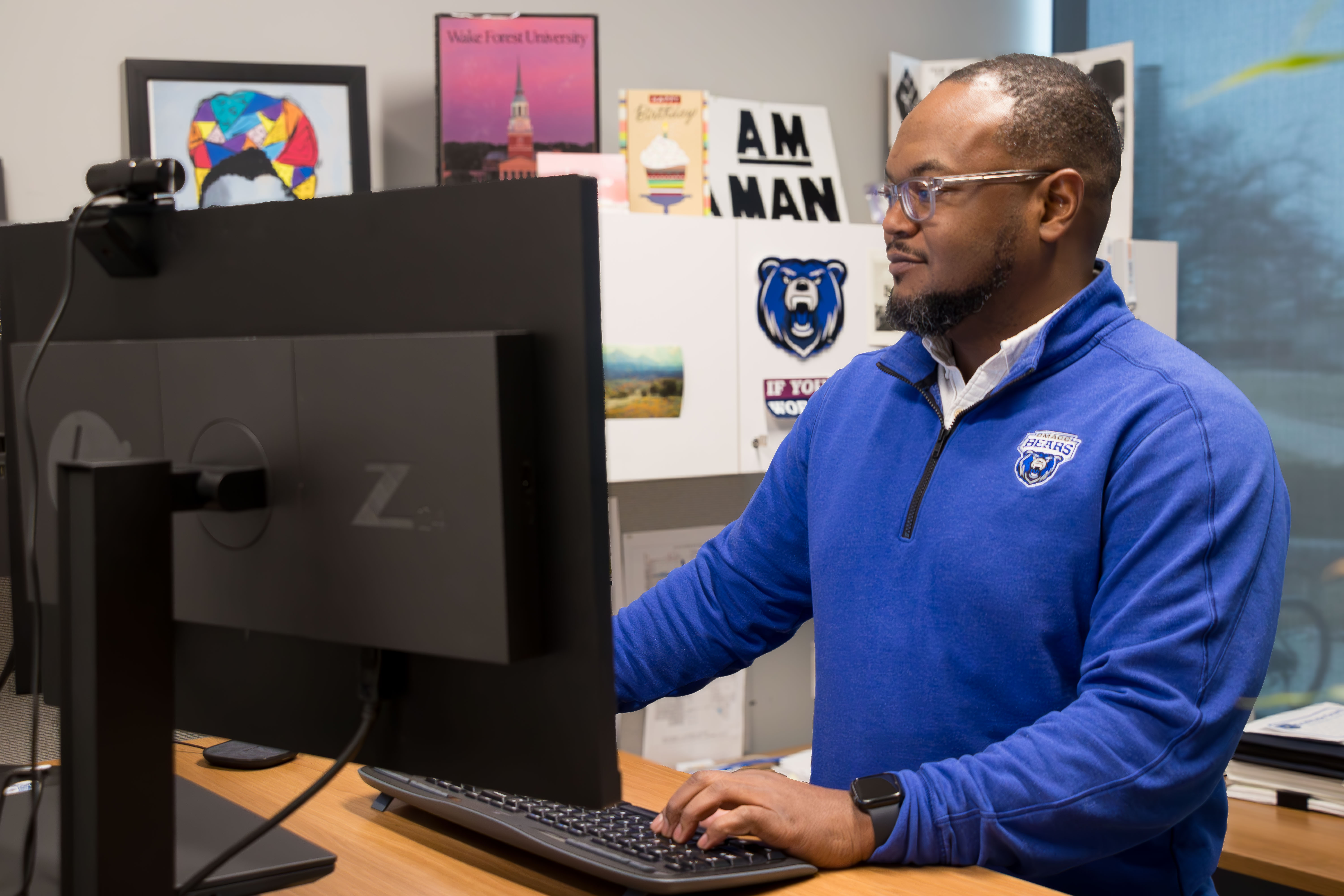
This chaotic personal anecdote is emblematic of the first-generation student experience to Dr. L. Wesley Harris Jr., DMACC’s Coordinator of Student Access & Success.
As a first-gen college graduate himself, Wesley is fiercely passionate about removing the barriers he once faced.
He believes student success goes beyond just propelling students through their programs; college is the time to find or rediscover passions and explore new opportunities, not robotically complete coursework for the sole pursuit of a diploma.
“I want to help students navigate college,” Wesley says, “But beyond that, how to navigate the world as adolescents and young adults.”
This desire to serve as a guide, he admits, spawned from his own lived experience.
“I wanted to go to college,” he reflects, “But growing up in a small town with parents that didn’t go to college, I didn't really know what that meant.”
Wesley reached out to a school counselor at his high school in Albemarle to answer that question, but after an unfulfilling experience, he realized he had to fend for himself.
He pushed himself to hunt for opportunities and resources; he sought out colleges, talked to people, attended events.
Wesley’s persistence – and unwillingness to take no for an answer – led him to the North Carolina School of Science and Mathematics, a high-ranking public residential high school in Durham, NC, where he graduated in 2001.
Wesley credits that high school, which was 2.5 hours away from his hometown of Albemarle, with changing his life trajectory, teaching him college competencies, and later enabling him to attend Wake Forest University in August of the same year.
“I don't want other students to experience barriers the way that I did,” he explains, “I want to be a door opener, and door holder, not a gatekeeper.”
Indeed, Wesley’s commitment to student access and student success extends outside DMACC’s campuses.
He served on the Ames Community School District’s School Improvement Advisory Committee and volunteered with Raising Readers of Story County in honor of a close friend. Alongside this work, he founded Black Gravity Educational Consulting as a graduate student, a practice that partners with educational institutions to develop programming focused on student success, access, and mental health, among other topics.
Needless to say, Wesley knows how to give students the extra push they need to cross the finish line.
Which brings us to the present day, and to Wesley’s efforts with First to Finish!
In 2025, he wrote and applied for a Local College Access Network (LCAN) grant, through a partnership with the Iowa Department of Education. DMACC was also selected as one of the 60 colleges to join the FirstGen Forward Network in 2025, which recognizes and helps institutions advance their efforts to support first-generation student success.

First-generation college students face often-overlooked challenges. Filling out the FAFSA, writing admission and scholarship essays, moving on campus, and other nuances of college life are much easier with parental support, especially if the students’ parents have been through the process themselves.
DMACC offers wraparound services – such as retention support, financial aid guidance, and career readiness resources – to help these students not only enroll but succeed.
The new first-generation space in Ankeny Campus’ Bldg. 5, R. 1209, next to the eSports Arena, will provide a community and network for students who need support to navigate the complex process, or are just looking for friends in the same boat.
A first-generation student, by the federal definition, is “Someone whose parents or legal guardians did not complete a four-year bachelor's degree in the U.S.”
Many students know their parents didn’t attend (or didn’t finish) college but simply don’t put two and two together, Wesley noted.
“College applications ask you to check boxes with your parents’ highest level of education,” he starts, “But after you do, there’s no pop-up letting you know, ‘Congratulations, you're a first-generation student!”
Wesley is working to identify ways First to Finish! might eventually leverage application form data, for example, to connect with students who checked that box, reach out, and say “You’re not alone. There’s a place for you here.”
As a coordinator, he has one clear goal: helping students get the most out of DMACC.
“Each campus hosts a unique student body,” Wesley points out, “but they all have one thing in common: they’re enrolled at DMACC and hope to achieve whatever it is they applied for.”
Many students might not fall directly under the “first-generation” umbrella, at least not as defined by the Department of Education. But if a student didn’t grow up in a household with a parent who went to college, or if they’re estranged, or just not receiving any kind of support from a parent or guardian, the resources at DMACC are available to anyone who seeks them.
Wesley shared a story about a student he jokingly nicknamed “The Mayor of the Food Court,” because of how friendly he was to everybody at the popular lunch spot in Building 5/Student Center at Ankeny Campus.
Wesley, too, likes to wander around the food court during his break, making acquaintances with Mr. Mayor.
“Mayor” was a first-semester student, fresh out of high school and still finding his footing. Though not technically first-generation, by definition, he navigated college as many first-gen students do – unsure where to go or who to contact. So, when the Mayor needed help, advice, or just ease of mind, he’d stop by Wesley’s office for guidance.
Wesley wasn’t the student’s assigned advisor, but “Mayor” needed help, and that’s all that mattered.
Shortly after Mayor O’ Food Court graduated, Wesley received an email thanking him for his time, conversations, and encouragement.
“I read ‘Thank you for being a part of my journey’, and that really touched me”, recalled Wesley, smiling.
In the same email, The Mayor shared that he’d achieved his post-DMACC goals: acceptance to both Drake and Iowa State.
“That message was a reminder that I am doing good work,” Wesley added, “I’m grateful for the opportunity to make a difference in students’ lives.”
Bear Trails highlights unique journeys of DMACC students, alumni, faculty, and staff, celebrating their diverse experiences and inspiring paths.
Have a story idea? Contact Savannah Eadens, Public Relations & Communications Specialist, at sjeadens@dmacc.edu or 515-675-3275.